
Open a cabinet door. Before you see the finish, before you register the weight of the panel, your hand has already formed an opinion.
The handle tells you everything in half a second: heavy or light, warm or cold, smooth or rough, premium or cheap. That first touch is the moment your customer decides whether the price tag is justified.
For furniture buyers and OEM procurement managers placing bulk orders from China, the handle is often the last item specified and the first to generate complaints after delivery. The most common failures are not price disputes or lead time misses — they are color deviations on arrival, plating that lifts within three months, zinc alloy that oxidizes white in humid climates, and stainless steel that turns out not to be stainless at all.
Every one of those failures starts with the same root cause: the material was not correctly specified before the order was placed.
The global furniture hardware market reached approximately $21 billion in 2024. China supplies over 60% of the world's furniture hardware exports, and for good reason — the combination of manufacturing depth, surface finish capability, and price competitiveness is unmatched. But that supply depth also means the quality range is enormous. Two handles that look identical in a product photo can be separated by a three-year difference in service life.
This guide gives procurement managers, furniture brands, and wholesale importers a material-first framework for bulk purchasing furniture handles from China. We cover the four main materials — zinc alloy, aluminum alloy, iron/cold-rolled steel, and stainless steel — with the technical parameters, sourcing risks, and quality checkpoints you need before placing your next order.
Most buyers negotiate on price first. Material specification should come first.
The reason is simple: material determines four variables that price cannot compensate for once the goods are in transit.
|
Variable |
What It Determines |
|
Weight feel |
The user's immediate quality perception — heavier reads as premium |
|
Surface durability |
How long the finish holds in the actual end-use environment |
|
Manufacturing process |
What shapes are achievable, lead times, and realistic MOQs |
|
Total landed cost |
Material cost + defect rate + return and replacement risk |
The price difference between a zinc alloy handle and an iron handle of identical appearance can be 30–50%. That saving evaporates if the iron handles arrive with surface rust from ocean transit, or if the zinc alloy handles develop white oxidation in a coastal market and generate warranty claims six months after delivery.
The cost of a bulk handle return — freight, customs duties, replacement sourcing, and lost customer confidence — typically runs 10–15 times the per-unit saving that motivated the cheaper specification in the first place.
Specify the material correctly before negotiating the price. Everything else follows from that decision.
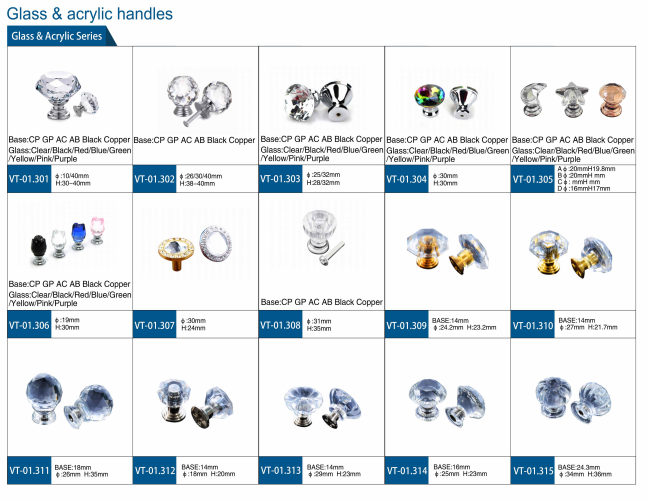
Zinc alloy handles are produced from Zamak alloy — a family of alloys whose name derives from its primary components: Zinc, Aluminum, MAgnesium, and Kupfer (copper). The dominant production process is die casting, which forces molten alloy into precision steel molds under high pressure.
Die casting is what makes zinc alloy the dominant material in decorative furniture hardware. The process can reproduce fine surface textures, undercuts, and complex three-dimensional forms that are impossible or prohibitively expensive to achieve in aluminum extrusion or stainless steel stamping. If a handle has ornate scrollwork, detailed knurling, or an organic sculptural form, it is almost certainly zinc alloy.
Zinc alloy is the most widely used furniture handle material globally, covering the full spectrum from entry-level to mid-high-end products.
Design flexibility is unmatched. Die casting allows surface detail that no other mass-production process can replicate at comparable cost. Floral patterns, rope textures, Art Deco geometric forms, and aged bronze effects — all of these are native to zinc alloy die casting.
Surface finish compatibility is broad. Zinc alloy accepts electroplating (nickel, chrome, gold, antique bronze, gun metal), powder coating, and PVD with high color fidelity. The same base casting can be finished to look like polished gold, aged bronze, brushed nickel, or flat black, giving product teams flexibility without retooling.
The weight feel is right for mid-to-premium positioning. Zinc alloy is denser than aluminum but lighter than cast iron — approximately 6.6 g/cm³. This places it in a weight range that reads as quality without feeling heavy or unwieldy. For knobs and small pulls, this density is an asset.
Production efficiency supports large volume orders. Die casting cycle times are short, tooling can be amortized across high volumes, and lead times for standard sizes are predictable.
White rust in humid environments. Zinc oxidizes in moist air to produce zinc oxide — a powdery white residue that appears as white spots or a chalky bloom on the handle surface. This is not a cosmetic nuisance; it indicates the base metal is exposed and active corrosion is underway. It is particularly common in Southeast Asia, coastal Europe, Australia, and other high-humidity markets.
The solution is correct plating specification, not thicker zinc. Require a minimum plating stack of: copper base ≥ 3 μm + nickel intermediate ≥ 5 μm + decorative top layer ≥ 0.5 μm, plus a clear lacquer seal coat over the finished surface. Require a salt spray test certificate of ≥ 48 hours for residential products; ≥ 72 hours for export to high-humidity markets.
Casting porosity. Low-pressure or improperly controlled die casting produces internal voids (porosity) in the casting. These voids create pinholes and bubbles on the surface after plating, and they accelerate corrosion by providing channels for moisture to reach the base metal. Porosity is invisible in product photos and undetectable without physical samples or cross-section inspection.
Request a porosity inspection report for new suppliers — specifically, a cross-section photograph of the casting at the thinnest wall section. Reputable manufacturers can provide this.
Lead content compliance. Some low-cost suppliers use off-grade zinc alloy with lead content above the Zamak standard. Lead-containing alloys are non-compliant with EU RoHS and REACH regulations and will fail customs inspection in European markets. Require a material composition report confirming compliance with RoHS Directive 2011/65/EU and REACH SVHC restrictions before approving a supplier for European distribution.
Zamak 3
(general use) or
Zamak 5
(higher strength, heavy-use applications)
Furniture style: European classical, American traditional, French provincial, Art Deco, modern luxury
Product type: Cabinet door handles, drawer pulls, wardrobe handles, decorative knobs
Target markets: Europe, North America, Middle East (decorative hardware segments)
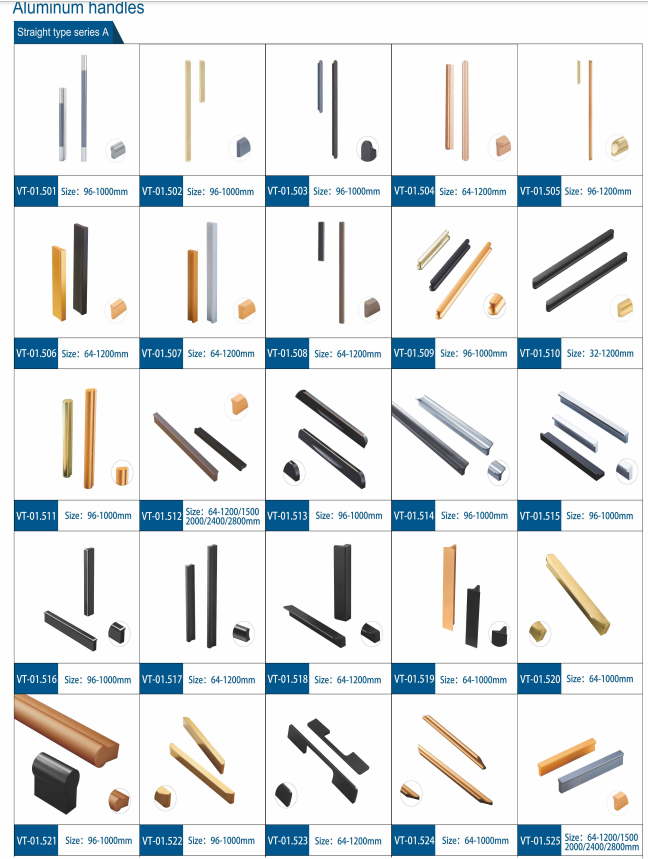
Aluminum furniture handles are produced primarily through two processes: extrusion (for long-bar and linear profiles) and die casting (for shaped handles). The dominant alloy for extruded handles is 6063-T5; ADC12 is standard for die-cast aluminum.
At approximately 2.7 g/cm³, aluminum is the lightest of the four main handle materials — roughly 40% of the density of zinc alloy. This weight difference is imperceptible in small knobs but becomes significant in long bar handles (200 mm+), where aluminum's lower weight improves the ergonomics of daily use.
Inherent corrosion resistance. Aluminum forms a dense, self-repairing oxide layer on contact with air. Without any surface treatment, aluminum already outperforms zinc alloy and iron in humid environments. This makes it a viable option for kitchens and bathrooms at lower cost than stainless steel, provided the anodizing specification is correct.
Anodizing produces a uniquely durable surface. Anodizing is an electrochemical process that thickens and hardens the natural aluminum oxide layer. The resulting surface has a hardness approaching that of sapphire — approximately 85% on the Mohs scale — making it highly resistant to scratching and abrasion under normal use. No other common handle material can be anodized; this process is exclusive to aluminum.
Anodized finishes available in brushed silver, champagne gold, matte black, and bronze are currently among the highest-selling SKUs in the European kitchen hardware market.
Extrusion enables perfect linear geometry. The extrusion process produces handles with consistent cross-sections and perfectly straight profiles — the physical embodiment of minimalist design. The Scandinavian and Japandi aesthetic movements, both of which prioritize precise, unornamented line work, are naturally served by extruded aluminum handles.
Large-format handles feel right in aluminum. For integrated pull handles on wardrobe sliding doors or long kitchen drawer handles, aluminum's lighter weight prevents the "top-heavy" feeling that would result from the same design in zinc alloy or steel.
Batch color variation in anodized finishes. Anodizing is sensitive to alloy consistency, bath chemistry, and temperature. Color output — particularly in black and dark finishes — can vary meaningfully between production batches. For a large order split across multiple production runs, uncontrolled color variation results in visible mismatches when handles are installed side by side.
Require each batch to be measured against an approved color standard. Specify maximum color deviation at ΔE ≤ 1.5 (measured with a spectrophotometer against a Pantone or RAL reference). This should be written into the purchase order, not left to verbal assurance.
Scratch visibility on anodized surfaces. Despite anodizing's hardness, sharp impact from metal objects leaves visible scratches that cannot be polished out without stripping and re-anodizing the surface. The risk occurs primarily in transit and on the production floor during installation.
Require individual EPE foam packaging for each handle — loose bulk packaging causes surface-to-surface abrasion that generates scratches before the handles reach the end customer.
Limited design complexity from extrusion. Extrusion produces uniform cross-sections. If your design requires varying thickness, three-dimensional relief, or complex surface detail, aluminum extrusion cannot deliver it. For those requirements, zinc alloy die casting is the correct material.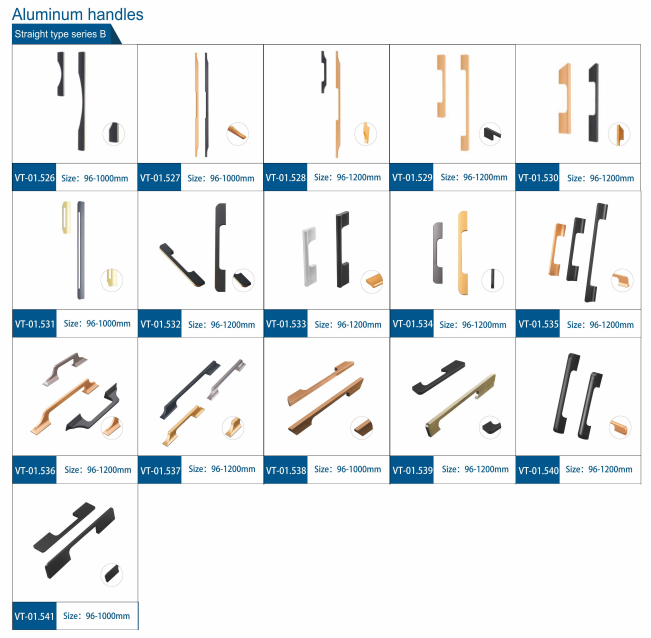
6063-T5
(extrusion);
ADC12
(die casting)
Furniture style: Scandinavian, modern minimalist, Japandi, contemporary industrial
Product type: Long bar cabinet handles, linear wardrobe pulls, recessed door grips, bathroom hardware
Target markets: Germany, Netherlands, Nordic countries, Australia, Canada
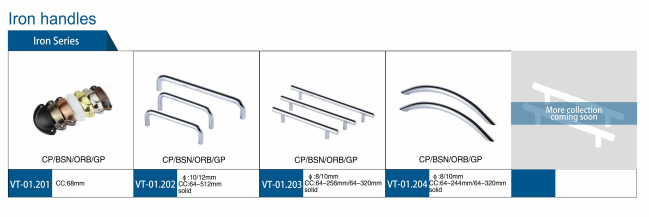
Iron furniture handles are produced through stamping (cold-rolled steel sheet), welding, or casting (cast iron). Cold-rolled steel stamping is the dominant process for standard flat and bar handle forms; cast iron is used for thicker, more sculptural designs in industrial and rustic styles.
Iron is the most structurally strong of the four handle materials at equivalent thickness. Cold-rolled steel has higher tensile and impact strength than zinc alloy or aluminum — relevant for large pull handles on heavy cabinet doors.
Lowest material cost. An iron handle of equivalent size and finish typically costs 20–40% less than a zinc alloy equivalent. For price-sensitive markets or high-volume private-label programs where margin is the primary constraint, iron handles offer the most competitive entry point.
Industrial and farmhouse aesthetics are native to iron. The weight, slight surface texture, and material honesty of cast iron cannot be convincingly replicated in zinc alloy or aluminum. For Farmhouse, American country, and industrial loft furniture styles, iron is not the budget alternative — it is the correct material. A matte black powder-coated iron handle on a shaker cabinet reads as intentional; the same form in zinc alloy reads as imitation.
Matte black powder-coated iron handles are among the best-selling hardware SKUs globally. The combination of flat black finish, clean geometry, and competitive price has made this SKU the default specification for the Farmhouse and transitional kitchen segments in North America and the UK. If this is your target category, iron is your material.
Structural strength for heavy-duty applications. For large barn-door pulls, heavy wardrobe handles, or commercial-use cabinet hardware, cold-rolled steel at 2.0 mm+ wall thickness provides structural confidence that zinc alloy at equivalent dimensions cannot match.
Rust is iron's fundamental weakness. Iron has no inherent corrosion resistance. The entire protection of an iron handle depends on its surface coating — and only its surface coating. Any breach in that coating, however small, initiates active rust at the exposed metal.
Critical rule: Do not specify iron handles for kitchens, bathrooms, laundry rooms, or any environment with regular moisture exposure. In these applications, the coating will eventually fail at edges, screw holes, and mounting points, and rust will follow. Stainless steel or anodized aluminum is the correct specification for these environments.
For dry interior applications — bedrooms, living rooms, studies, and wardrobes in temperate climates — properly specified iron handles perform well. Require powder coat thickness ≥ 60 μm; below this threshold, coating adhesion is insufficient for long-term performance.
Ocean transit rust. Container shipping subjects goods to significant humidity variation and salt air exposure, particularly on long-haul routes to Europe and North America. Iron handles with thin or imperfect coating develop surface rust during transit — arriving at the destination with visible reddish-brown spots before they have been used once.
Require individual packaging with a silica gel desiccant packet per carton, and specify that handles receive an anti-rust oil treatment (thin film, water-soluble) before packaging. This adds minimal cost and eliminates transit rust.
Weight inconsistency in stamped handles. Cold-rolled steel stamping produces handles from sheet metal; thickness variation in the raw sheet translates to weight and feel variation between units in the same batch. For premium products where consistent hand-feel is a quality signal, this variation is perceptible.
Specify wall thickness tolerance at ± 0.2 mm and include weight range in the acceptance criteria. Implement a sample check rate of ≥ 5% for weight consistency before accepting bulk shipments.
not recommended for kitchens, bathrooms, or high-humidity environments
Furniture style: Industrial loft, Farmhouse, American country, matte-black minimalist
Product type: Cabinet pulls, drawer handles (non-kitchen/bath), bookcase hardware, decorative iron fittings
Target markets: North America (Farmhouse segment), United Kingdom, Eastern Europe
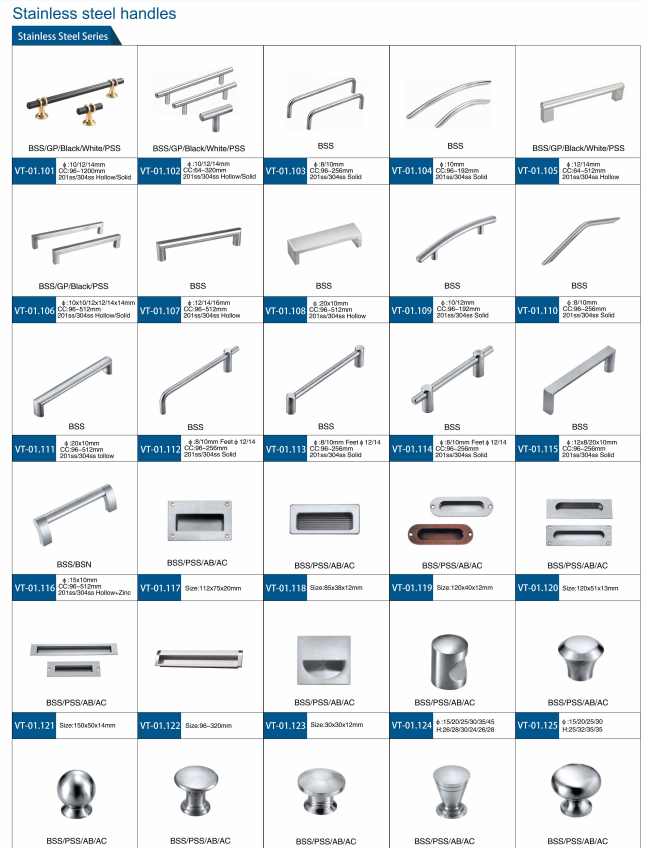
Stainless steel furniture handles are produced from chromium-containing steel alloys that form a self-repairing passive oxide layer, providing inherent corrosion resistance without surface coating. The three grades relevant to furniture hardware are:
Grade 304 (18/8):
Grade 201:
Grade 316:
Production processes include stamping, deep drawing, welding, and tube bending. Surface finishes include brushed (the dominant choice for modern kitchens), mirror polished, and PVD-coated color finishes (gold, black, rose gold).
True corrosion resistance — no coating required. Grade 304 stainless steel in normal kitchen and bathroom environments does not rust, stain, or corrode. The chromium oxide passive layer is self-repairing: minor scratches re-passivate on contact with air. This is not a coating that can lift, chip, or wear through — it is a property of the material itself.
Kitchen applications demand it. Steam, cooking oils, cleaning chemicals, and regular wet-hand contact create a corrosion environment that iron handles cannot survive and zinc alloy handles manage poorly. Grade 304 stainless steel is the only handle material that handles these conditions reliably across a 10+ year product life.
Brushed stainless steel is the current leading specification for premium kitchen hardware. The combination of the material's inherent quality signal and its visual compatibility with quartz countertops, matte cabinet finishes, and integrated appliances has made it the default specification for mid-to-high-end kitchen renovations across Europe, Australia, and North America.
PVD coating delivers durable color on a stable base. Physical Vapour Deposition (PVD) applies a thin metallic film — typically titanium nitride for gold, or chromium nitride for black — to the stainless steel surface. The result is a colored handle with hardness significantly greater than electroplating, and color stability measured in years rather than months. PVD black and PVD gold stainless steel handles are the premium alternative to powder-coated iron and gold-plated zinc alloy, respectively.
Food safety compliance. Grade 304 stainless steel meets FDA and EU food contact material regulations. In markets with strong food safety awareness — Germany, Scandinavia, Australia — specifying food-grade hardware is a verifiable product claim that supports premium positioning.
This is the most common and commercially damaging material fraud in the Chinese furniture hardware supply chain.
Grade 201 stainless steel substitutes manganese for nickel to reduce alloy cost. The result looks identical to 304 in product photos, passes visual inspection, and costs 20–35% less. It also rusts — typically within 24–72 hours of salt spray exposure, and within months in real kitchen and bathroom environments.
|
Property |
Grade 304 |
Grade 201 |
|
Nickel content |
≥ 8% |
< 1% |
|
Chromium content |
18% |
13–15% |
|
Corrosion resistance |
Excellent |
Poor in humid / chloride environments |
|
Salt spray (ISO 9227) |
> 200 hours without rust |
24–72 hours before rust spots appear |
|
Price vs. 304 |
Baseline |
20–35% lower |
|
Magnet response |
Weak or non-magnetic |
Slight magnetic response |
How to verify the grade before you pay:
Note: the magnet test (304 is weakly magnetic or non-magnetic; 201 is slightly magnetic) is a useful field indicator but not a reliable purchasing criterion. Proper 304 with residual stress from forming can show magnetic response; this test should trigger further investigation, not a final decision.
PVD layer thickness. PVD coatings below 0.3 μm thick will show color fade within 12 months of regular use. Specify PVD layer thickness ≥ 0.3 μm and request a deposition thickness report from the supplier's coating run records.
Weld joint quality. On tubular and fabricated stainless steel handles, the weld joint is the first location where corrosion initiates — weld spatter, heat-affected zones, and incomplete fusion all compromise the passive layer. Require weld joints to be fully ground, polished flush with the surrounding surface, and passivated after fabrication.
304
(residential kitchen and bathroom);
316
(coastal, marine, or outdoor applications)
Furniture style: Modern minimalist, contemporary kitchen, high-end bathroom, Nordic industrial
Product type: Kitchen cabinet handles (primary specification), bathroom hardware, appliance pulls, door hardware
Target markets: Germany, United Kingdom, Australia, North America (kitchen renovation segment)
Use this table as your primary decision reference. Every row represents a dimension that should be confirmed before specifying.
|
Dimension |
Zinc Alloy |
Aluminum Alloy |
Iron / Steel |
Stainless Steel 304 |
|
Relative cost |
Medium |
Medium |
Low |
High |
|
Weight feel |
Medium-heavy |
Light |
Heavy |
Medium |
|
Corrosion resistance |
Medium (coating-dependent) |
Good (anodized) |
Poor (coating-dependent) |
Excellent (inherent) |
|
Design complexity |
Highest (die cast) |
Medium (extrusion) |
Medium (stamp/cast) |
Low–medium |
|
Kitchen / bathroom suitability |
Marginal |
Good |
Not recommended |
First choice |
|
Primary design styles |
European, luxury, vintage |
Nordic, minimalist, Japandi |
Industrial, Farmhouse, black |
Modern, kitchen, premium |
|
Main sourcing risk |
White rust, porosity, RoHS |
Batch color variation |
Transit rust, humidity damage |
201 fraud |
|
Key certification |
RoHS / REACH |
None specific |
None specific |
Food-grade (kitchen use) |
Question 1 — Is the end-use environment a kitchen, bathroom, or high-humidity space? → Yes: specify Grade 304 stainless steel. No other material is appropriate for long-term performance in these environments. → No: proceed to Question 2.
Question 2 — Is the design style modern minimalist, Scandinavian, or Japandi? → Yes: specify aluminum alloy with anodized finish. The linear geometry and surface quality are native to this material. → No: proceed to Question 3.
Question 3 — Does the design require complex decorative detail, or is cost the primary constraint? → Complex decoration: specify zinc alloy (die cast). No other material achieves this at scale. → Cost priority, dry interior: specify iron / cold-rolled steel with powder coat.
Sourcing is not complete when the purchase order is signed. These five steps protect your investment between order placement and goods acceptance.
Every material parameter must appear in the Purchase Order or Technical Specification document — not in a chat message, not in a verbal confirmation.
Do not write "zinc alloy handle, chrome finish." Write: "Zamak 3 zinc alloy, minimum wall thickness 2.8 mm, copper base plating ≥ 3 μm + nickel ≥ 5 μm + chrome ≥ 0.3 μm + clear lacquer seal coat, salt spray resistance ≥ 48 hours per ISO 9227."
A supplier who pushes back on written specifications is telling you something important about how they intend to manage quality when no one is watching.
|
Material |
Required Documents |
|
Zinc alloy |
RoHS / REACH compliance report (SGS, BV, or Intertek) |
|
Aluminum |
Alloy grade certificate; anodizing thickness report |
|
Iron / steel |
Powder coat thickness test report; salt spray report |
|
Stainless steel |
Mill Test Certificate (Ni ≥ 8%); salt spray report ≥ 96 hours |
Any supplier who cannot provide these documents for an existing product line does not have the documentation infrastructure to support consistent quality production. For new product development, factor the testing timeline into your lead time planning.
Agree on these parameters in writing before the production sample is submitted:
Dimensional tolerance:
Surface:
Color consistency:
Function:
Approved samples should be physically retained — one set with you, one set sealed at the factory — as the reference standard for bulk production acceptance.
For orders above your minimum risk threshold, implement pre-shipment inspection using AQL 2.5 sampling — a statistical sampling method that controls the acceptable defect rate at 2.5% across the batch.
Critical inspection points:
Build a simple supplier scorecard with four criteria:
After 2–3 purchase cycles, you will have objective data to guide allocation decisions. Concentrate volume with high-scoring suppliers; phase out low scorers regardless of unit price.
Veitop Hardware manufactures all four handle material types — zinc alloy, aluminum alloy, iron/cold-rolled steel, and grade 304 stainless steel — in standard catalogue configurations and full OEM custom development.
Standard quality commitments across all materials:
OEM custom development:
All certification documents — material certificates, salt spray reports, RoHS/REACH compliance reports — are provided as standard with every order, not on request.
What is the best material for furniture handles? There is no single best material — only the best material for a specific application. Stainless steel grade 304 is the correct specification for kitchens and bathrooms. Aluminum alloy is the natural choice for modern minimalist and Scandinavian design. Zinc alloy delivers the highest design complexity for decorative styles. Iron and cold-rolled steel offer the best value for dry interior applications and industrial or Farmhouse aesthetics.
Is zinc alloy good quality for cabinet handles? Yes — when correctly specified. Zamak 3 or Zamak 5 alloy with a proper copper-nickel-chrome plating stack and a salt spray rating of ≥ 48 hours is a robust, commercially proven specification for residential cabinet hardware. The risks — white rust and porosity — are manageable with correct surface treatment and supplier quality control. Problems arise when buyers accept inadequate plating thickness to reduce unit cost.
How do I tell grade 304 stainless steel from grade 201? Request a Mill Test Certificate from the steel mill showing the chemical composition — confirm nickel (Ni) content is ≥ 8.0%. Request a salt spray test report: 304 shows no rust after 96 hours; 201 shows rust within 24–48 hours. For significant orders, commission an XRF analysis from SGS, Bureau Veritas, or Intertek. The magnet test (201 is slightly more magnetic than 304) is a useful field indicator but not a reliable sole criterion.
Do aluminum furniture handles rust or corrode? No. Aluminum forms a self-repairing oxide layer that provides inherent corrosion resistance without any surface coating. Anodized aluminum is further hardened and color-stabilized, making it suitable for kitchens and bathrooms at lower cost than stainless steel. The primary risk with aluminum handles is surface scratching, not corrosion.
Do iron cabinet handles rust? Yes, without adequate surface protection. Iron has no inherent corrosion resistance and depends entirely on its surface coating. Powder-coated iron handles at ≥ 60 μm coating thickness perform well in dry interior environments such as bedrooms and living rooms. They are not suitable for kitchens, bathrooms, or humid climates. All iron handles shipped by ocean freight should be individually packaged with desiccant to prevent transit rust.
What is the minimum order quantity for bulk handles from China? At Veitop Hardware: 100 sets for standard catalogue items; 50 sets for OEM sample development. Contact our team to discuss tiered pricing for orders above 500 sets.
What documents should I always request when sourcing handles from China? At minimum: material composition certificate (Mill Test Certificate for stainless steel; alloy grade certificate for zinc alloy and aluminum), salt spray test report, surface treatment thickness report, and RoHS/REACH compliance report for zinc alloy products destined for European markets. For any new supplier relationship, add a third-party inspection report from SGS, Bureau Veritas, or Intertek before bulk payment.
The difference between a successful bulk handle sourcing program and a costly rework is not price negotiation — it is material specification made before the purchase order is issued.
Define the material grade. Lock the surface treatment parameters. Require the test reports. Validate with samples. Inspect before payment.
Veitop Hardware supplies furniture handles to manufacturers, wholesalers, and interior contractors across Europe, Australia, and North America. Our engineering team can recommend the correct material and finish specification for your product and target market before you commit to volume.
[Request Free Samples →] | [Contact Our Engineering Team →]
Download the Veitop Hardware Handle Catalogue — complete material specifications, surface finish options, dimensional drawings, MOQ tiers, and pricing for all handle ranges.
Veitop Hardware is a Guangdong-based OEM/ODM manufacturer specializing in sofa fittings, bed components, and furniture hardware, with 20+ years of production experience. We supply furniture manufacturers, interior designers, and project contractors worldwide. veitophardware.com