
A full-time office worker sits in their chair for more than 1,760 hours per year. During those hours, the swivel base beneath them absorbs something that rarely appears in product specifications: cumulative mechanical load. Every rotation of the seat, every forward lean, every height adjustment, every shift in posture transmits force through the base structure. Across a standard working year, that amounts to more than 80,000 individual mechanical cycles — and the base is the only component in the entire chair that simultaneously bears axial load from body weight, radial shear from rotation, and lateral bending moment from postural shifts.
The global ergonomic office chair market reached approximately $6.8 billion in 2024, with a projected CAGR of 6.8% through 2030, according to Grand View Research. Demand is being driven not by large corporations fitting out open-plan offices, but increasingly by individual professionals spending $300–$800 on home office chairs that must perform as reliably as commercial-grade seating — and be warranted accordingly.
Yet in most chair development programmes, the swivel base receives the least engineering scrutiny. Seat foam formulation, lumbar adjustment range, armrest geometry — these are the elements that show up in marketing materials and justify premium pricing. The base is treated as infrastructure: procure the cheapest viable option and move on. Market return data consistently contradicts this approach. Approximately 31% of office chair warranty claims and retail complaints are base-related: squeaking during rotation, spoke fracture under load, gas spring sinking that cannot be adjusted away. None of these are design failures in the conventional sense. They are the predictable outcome of under-specifying ergonomic office chair parts that happen to be invisible.
This article examines the swivel chair base as a mechanical system — five interdependent components, each with its own specification requirements — and provides the technical framework that procurement and product development teams need to make sourcing decisions that hold up over a five-year product lifecycle.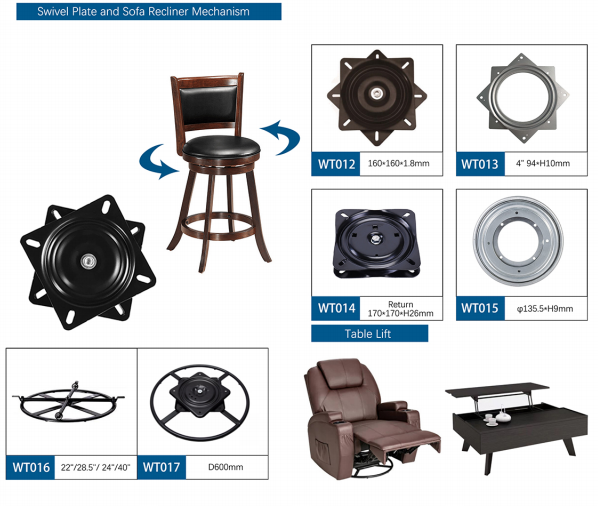
The term "chair base" is misleading in its simplicity. What is being purchased is a system of five structurally interdependent components. Treating any one of them in isolation — specifying the star base without considering the gas spring interface, or selecting casters without checking floor-contact compatibility with the overall load path — creates assembly risk that surfaces after units have shipped.
|
Component |
Primary Function |
Performance Dimension |
|
Star Base / Spoke Base |
Ground contact; distributes seated weight across five arms |
Stability, load capacity, tip resistance |
|
Center Hub / Tube |
Connects star base to gas spring; transmits axial and radial loads |
Load transfer efficiency, concentricity |
|
Swivel Bearing / Turntable |
Enables 360° free rotation |
Rotation smoothness, noise, service life |
|
Gas Spring Cylinder |
Provides infinite seat height adjustment within a defined stroke range |
Adjustment range, sink rate, cycle life |
|
Caster Sockets |
Interface between star arms and casters; determines mobility |
Caster compatibility, floor protection |
The load path connects all five: body weight applies axial force to the gas spring, which transmits through the center hub into the swivel bearing race, which distributes laterally into the star arms, which transfer to the floor through the casters. A dimensional deviation or material shortfall at any point in this chain — a hub that is 0.3mm off-center, a bearing race that is under-hardened, an arm with insufficient wall thickness — accelerates failure across the entire system under cumulative fatigue loading.
This is why the correct procurement unit for a chair base is not "a base" but "a base system" — with specifications confirmed at the component level before any production approval is signed.
Veitop Hardware addresses this with a matched product architecture: the Sofa Hardware Turntable Swivel Plate series covers standard and auto-return rotating bases across multiple diameter configurations, the A0110002 Chair Turntable Base provides a purpose-built auto-return solution for chair applications, and the Metal Furniture Leg series supplies compatible structural support elements for non-caster base configurations.
The star base is the component most buyers treat as a commodity and most engineers know is not. Diameter, material, wall thickness, and arm cross-section geometry all determine whether the base provides genuine structural support — or merely the appearance of it.
The five-arm design is not arbitrary. Geometric analysis of tip resistance across 360° of potential overload directions shows that a five-arm base provides a minimum anti-tip moment approximately 23% higher than a four-arm design and 52% higher than a three-arm design — at the same overall diameter. This is why both ISO 9241 (ergonomics of office work systems) and EN 1335 (the European office chair safety standard) require a minimum of five base contact points for any chair used in a seated work environment.
Six-arm bases exist for specific applications: heavy-duty commercial seating rated above 180 kg, medical procedure chairs, and industrial operator stations where lateral stability under asymmetric dynamic loads is a primary engineering requirement. For standard ergonomic office chairs, five arms remain the engineering optimum between stability and floor footprint.
The base material determines load capacity, impact resistance, weight, and the premium perception of the finished product. Four materials dominate the market:
|
Material |
Typical Load Rating |
Weight |
Impact Resistance |
Primary Application |
Relative Cost |
|
Glass-fibre reinforced nylon (PA66+GF30) |
120–150 kg |
Lightest |
Moderate |
Mass-market home seating |
1× |
|
Aluminium alloy die-cast |
150–200 kg |
Medium |
High |
Mid-to-high commercial seating |
2–3× |
|
Stamped / cast steel |
200–250 kg+ |
Heaviest |
Highest |
Industrial / heavy-duty commercial |
1.5–2× |
|
Zinc alloy die-cast |
150–180 kg |
Medium-heavy |
High |
Premium aesthetic applications |
2.5–3.5× |
The material selection decision should be driven by load rating and market positioning — not by minimising unit cost. A nylon base priced at one-fifth of an aluminium alternative delivers inferior performance at loads above 120 kg and communicates a product quality level inconsistent with a $400+ chair price point.
Spread diameter is the single most important geometric parameter for tip resistance. EN 1335 mandates a minimum external diameter of 630 mm for standard office chairs, with heavy-duty models requiring 700 mm or wider. Most mid-to-high-end specifications target 650–680 mm as the practical optimum: sufficient anti-tip margin without excessive floor footprint in confined workstation layouts.
The mechanical relationship is direct: a larger base diameter increases the horizontal distance between the chair's centre of gravity projection and the nearest contact point, raising the lateral force required to initiate tipping. A 650 mm base requires approximately 18% more lateral force to tip than a 580 mm base at the same seated load — a difference that becomes critical when users lean sideways to retrieve items from desk drawers.
Two bases at identical diameter and identical material can have static load ratings that differ by more than 40%, driven entirely by arm wall thickness and hub reinforcement geometry. High-quality aluminium alloy bases specify a minimum arm cross-section wall thickness of 3.5 mm and a hub reinforcement zone wall thickness of 8 mm or greater. These figures should appear in the component drawing, not merely as claims in a product description. Require suppliers to provide sectional drawings or — for high-volume sourcing decisions — CT scan reports of production samples before approval.
The bearing is where the chair's rotational performance originates, and where it degrades. A bearing that operates smoothly on day one but develops audible friction by month eighteen has not failed — it has performed exactly as its specification predicted. The procurement question is whether that specification was adequate for the intended use cycle.
Ball bearing (recirculating steel balls in a hardened race) Ball bearings operate at friction coefficients of 0.001–0.005, delivering the smoothest possible rotation with the lowest activation torque. Dynamic load capacity for precision-grade chair bearings reaches 150–200 kg. Noise output in a correctly specified and lubricated bearing is below 30 dB — effectively inaudible in a standard office environment. Service life at rated load is ≥ 100,000 rotation cycles for high-quality specifications.
Ball bearings are the correct specification for any chair used in a knowledge-work environment where users rotate frequently — reaching across a desk, turning to address colleagues, shifting between screens. The smoothness of a ball bearing is not a luxury feature; it is the mechanism that allows unconscious, low-effort postural adjustment throughout the working day.
Roller bearing / needle bearing (cylindrical rollers in a hardened race) Roller bearings sacrifice rotational smoothness for radial load capacity. They are appropriate for applications where loads consistently exceed 180 kg, where dynamic shock loads are expected (industrial environments), or where the cost differential justifies the performance compromise. Noise output under normal operating conditions is ≤ 40 dB. For standard ergonomic office chairs, roller bearings represent an unnecessary trade-off.
The Veitop Hardware A0110002 Chair Turntable Base adds a dimension to swivel function that standard bases do not provide: automatic return to the default orientation after rotation. The mechanism uses an internal torsion spring calibrated to smoothly drive the base back to its preset forward-facing position — within ±5° — when the user releases rotational force.
This is not a niche feature. It directly addresses three common commercial seating applications where a fixed default orientation has operational value:
Reception and front-desk chairs:
Conference room presider chairs:
Operator workstation chairs:
Key specifications for the A0110002:
Understanding why bearings fail is the most practical guide to preventing them from failing. The table below maps the four most common field failure modes to their root causes and corresponding procurement-stage prevention measures:
|
Failure Symptom |
Root Cause |
Prevention at Procurement |
|
Squeaking during rotation |
Ball precision below G16 grade, or lubricant desiccation |
Require specification sheet to state ball precision grade (≥ G16) and lubricant type with rated service life |
|
Progressive increase in rotation resistance |
Race surface wear or lubricant migration |
Require seal grade specification and lubricant retention life (≥ 5 years at rated load) |
|
Single-direction rotation stiction |
Upper/lower race concentricity deviation |
Require concentricity tolerance ≤ 0.05 mm with dimensional inspection report |
|
Uncontrolled free-spin after release (auto-return models) |
Torsion spring fatigue failure |
Require spring cyclic fatigue test report: ≥ 50,000 cycles at rated torque |
The gas spring is the component that makes seat height adjustable, and it is also the component most consistently compromised during cost-reduction exercises. The consequences are predictable: a chair that sinks 8 mm per year will, within three years, sit outside the ergonomic height range for a significant portion of users — and generate warranty claims that cost more to process than the difference between a compliant and a non-compliant gas spring specification.
EN 1335-3 requires a minimum seat height adjustment range of 110 mm for standard office chairs (typically 400–530 mm from floor to seat pan). This range exists because the ergonomically correct seat height is individual — determined by the user's leg length, desk height, and monitor position. A chair that cannot be adjusted to the correct height for a given user does not merely feel uncomfortable; it forces the user into postures that increase musculoskeletal load on the lumbar spine, hip flexors, and posterior shoulder chain over the course of the working day.
The gas spring is the only mechanism that delivers this adjustment. When the user depresses the actuation lever, the pneumatic lock releases and body weight compresses the nitrogen-charged piston to the desired height. Release the lever: the position locks. The smoothness, precision, and durability of this cycle determine whether the chair maintains its ergonomic specification throughout its service life.
|
Parameter |
Home / Light Commercial |
Heavy Commercial / Industrial |
|
Stroke |
≥ 110 mm |
≥ 130 mm |
|
Maximum rated load |
≥ 120 kg |
≥ 160 kg |
|
Annual sink rate |
≤ 5 mm/year |
≤ 3 mm/year |
|
Cycle life |
≥ 100,000 cycles |
≥ 200,000 cycles |
|
Nitrogen purity |
≥ 99.5% |
≥ 99.9% |
|
Certification |
BIFMA X5.1 or EN 1335-3 |
Same, with third-party test report |
Nitrogen purity is a specification that rarely appears in supplier discussions but has a direct impact on low-temperature performance. In cold environments — warehouses, loading docks, facilities in northern climates — gas springs filled with nitrogen below 99.5% purity can exhibit increased internal viscosity, resulting in sluggish actuation and accelerated seal degradation. For any product specification targeting markets with cold-climate distribution, 99.9% nitrogen purity should be a baseline requirement.
The global standard for gas spring-to-hub interface is a 30 mm tapered cone (approximately 85% market share). Non-standard interfaces — 28 mm and 35 mm tapered cones — are used in premium designs and some proprietary platforms. The interface specification matters less than the precision with which it is manufactured: a gas spring cone that fits the hub with more than 0.5 mm of lateral play at the mating surface will transmit that play as perceptible seat wobble under dynamic load.
Do not accept a supplier's assurance that a gas spring "fits standard interfaces." Require the mating tolerance specification — specifically, the allowable lateral displacement at the cone-to-hub interface under a defined lateral test load — to appear in the component drawing. This single parameter is responsible for more field complaints about chair instability than any other gas spring specification.
European gas spring brands — principally Stabilus and Bansbach — command a 3–5× price premium over equivalent Chinese specifications. That premium is justified in a specific and narrow application: chairs used in environments with cycle frequencies above 500 actuation cycles per day (call centres, trading floors, high-throughput reception desks) where the cumulative fatigue loading over a five-year service life genuinely differentiates premium from standard cycle life specifications.
For home office chairs, standard commercial office chairs, and any application below 200 actuation cycles per day, Chinese manufacturers holding current BIFMA X5.1 and EN 1335-3 certification deliver equivalent functional performance at a fraction of the cost. The decision criterion is not brand origin — it is the match between the product's actual use frequency and the gas spring's certified cycle life rating.
Casters are frequently procured separately from the base, treated as a category-4 decision after star base, bearing, and gas spring are specified. This is a mistake. The caster selection determines the end user's daily tactile experience of the chair — rolling smoothness, noise, and floor protection — and the wrong choice generates the kind of visible, immediate damage to customers' floors that produces the most emotionally charged product complaints.
|
Caster Type |
Optimal Floor Surface |
Rolling Resistance |
Noise |
Key Consideration |
|
Hard nylon (PA) |
Carpet |
Low |
Low |
High-speed rolling; risks scratching hard floors |
|
Polyurethane-coated (PU) |
Hardwood, marble, tile |
Medium |
Near-silent |
Dual-material construction; best floor protection |
|
Rubber |
All surfaces |
High |
Lowest |
Maximum grip; suited to sloped or damp environments |
|
Cast iron (heavy duty) |
Factory/warehouse floors |
Highest |
High |
For loads > 250 kg; industrial applications only |
The polyurethane-coated caster has become the de facto specification for mid-to-high-end ergonomic chair products sold into residential and corporate office environments. Its dual-material construction — a hard structural core for load bearing combined with a soft PU outer layer — delivers the floor protection that hardwood and tile users expect while maintaining adequate rolling smoothness for normal office use. Specifying a hard nylon caster for a chair being sold into markets with predominantly hard floor surfaces is one of the most reliable ways to generate flooring damage complaints.
The global standard caster interface is the 11 mm grip ring stem (actual stem diameter 10.9 mm, designed to create an interference fit with an 11 mm socket). This interface is compatible with the caster sockets on the vast majority of five-arm bases manufactured to standard specifications. Non-standard interfaces — M10 or M12 threaded bolt connections — are used in heavy-duty industrial applications where the consequences of a caster separating under load are unacceptable.
The critical tolerance parameter is the interference fit between the caster stem and the socket bore: a fit of 0.1–0.3 mm interference is the functional target. Below 0.1 mm, the caster can work loose under lateral loading. Above 0.3 mm, press-fitting during assembly generates socket cracking — a failure mode that typically presents weeks after assembly when the cracked socket propagates under service load.
Locking casters — which prevent both wheel rotation and castor swivel — are specified for chairs used in medical facilities, precision assembly stations, and any environment with sloped floors where an unlocked chair would drift when unoccupied. Single-lock versions prevent wheel rotation only (the castor can still swivel); dual-lock versions immobilise both wheel and swivel direction.
The presence of locking casters on a chair changes the load path on the swivel base during normal use. When the chair is locked in position, users rotate the seat independently of the base, applying rotational torque directly to the swivel bearing without the base absorbing any horizontal movement component. This increases the bearing's radial load under rotation — a factor to account for when specifying bearing type and load rating for chairs with locking caster specifications.
Certification documentation is not a formality. It is the only objective evidence that a base system will perform as specified under the load conditions it will encounter in service. The challenge for procurement teams is that not all test reports are equally valid — and suppliers who provide inadequate documentation rarely volunteer that fact.
EN 1335 — European Office Chair Standard (Three Parts)
EN 1335 is the mandatory reference framework for all office chairs sold into European markets.
EN 1335-1:
EN 1335-2:
EN 1335-3:
A chair claiming EN 1335 compliance without a test report covering all three parts of the standard is not demonstrably compliant with all three parts. Request documentation for each separately.
BIFMA X5.1 — North American Commercial Furniture Standard
BIFMA X5.1 covers equivalent ground to EN 1335 for the North American market, with some methodological differences in how stability and durability tests are conducted. It is the baseline requirement for commercial office furniture procured by US corporate, government, healthcare, and educational organisations. Without BIFMA certification, office chairs are effectively excluded from corporate and institutional purchasing programmes in North America.
|
Test Name |
What Is Tested |
Pass Criterion |
|
Tip stability test |
110 N lateral force applied in the least stable direction |
No tipping; no permanent deformation |
|
Spoke arm strength test |
1,500 N vertical downward force at arm tip |
No fracture; permanent deformation ≤ 5 mm |
|
Gas spring durability test |
100,000 full-stroke actuation cycles |
Sink ≤ 5 mm; no pressure loss |
|
Swivel bearing durability test |
100,000 full rotation cycles |
No audible noise development; torque change ≤ 30% |
|
Caster rolling test |
1,000 m at rated load |
No separation; no significant wear |
Procurement teams reviewing test reports should treat the following as disqualifying signals:
Red Flag 1 — Report date more than three years old. Material formulations and production tooling change. A test report from 2021 provides no assurance about the product being manufactured in 2026.
Red Flag 2 — Test sample specification does not match current production. If the report specifies a 3.8 mm arm wall thickness and the current production drawing shows 3.2 mm, the report is not evidence of current product performance.
Red Flag 3 — Only a finished-chair report, no component-level report. A complete chair test covers the integrated system but cannot isolate the base's individual performance parameters. Require a base-level test report in addition to any complete-chair certification.
Red Flag 4 — Test conducted by the supplier's own laboratory. Third-party certification requires a third-party laboratory. Acceptable testing bodies include SGS, TÜV Rheinland, Intertek, and Bureau Veritas. A factory self-test report is a quality control document — not a certification.
The five sections above provide the technical foundation. This section consolidates that information into two practical tools: a scenario-based specification matrix and a ten-parameter RFQ checklist.
|
Application |
Base Material |
Base Diameter |
Gas Spring Stroke |
Swivel Mechanism |
Caster Type |
Certification |
|
Home ergonomic chair |
PA66+GF30 nylon |
650 mm |
110 mm |
Standard ball bearing |
PU-coated |
EN 1335 (baseline) |
|
Mid-to-high commercial office |
Aluminium alloy die-cast |
680 mm |
120 mm |
Precision ball bearing |
PU-coated |
EN 1335 + BIFMA X5.1 |
|
Conference / reception seating |
Aluminium alloy die-cast |
650 mm |
110 mm |
Auto-return (A0110002) |
PU-coated |
EN 1335 |
|
Heavy-duty commercial / industrial |
Stamped steel |
700 mm |
130 mm |
Roller bearing |
Locking caster |
EN 1335 + independent load test |
|
Bar stool / high chair |
Aluminium alloy or steel |
350–450 mm |
140–200 mm |
Standard or auto-return |
Custom foot or footrest ring |
Customer-specified |
Sending an RFQ without these parameters produces quotations that cannot be meaningfully compared and creates specification gaps that surface as quality problems after mass production has begun:
Star base material
Center hub internal diameter
Gas spring stroke
Swivel mechanism type
Caster type
Surface treatment
Target certification standard
Intended use classification
Annual volume
Packaging specification
Veitop Hardware's rotating base product line is structured to support the procurement approach this article describes — specification-first, documentation-supported, with OEM customisation where standard configurations do not match the product requirement.
The Sofa Hardware Turntable Swivel Plate series covers standard 360° rotation in multiple diameter configurations, suitable for chair, sofa, and accent seating applications requiring smooth, low-torque rotation. The A0110002 Chair Turntable Base is the purpose-engineered auto-return solution for reception, conference, and operator station seating — with adjustable return torque and optional rotation limiting. The Metal Furniture Leg series provides compatible structural support elements for chair base configurations that use fixed legs rather than casters.
OEM support includes: custom base diameter specification, auto-return torque calibration to match user weight range, surface treatment selection, and CAD drawing provision for integration into proprietary frame designs. Sample lead time is 15 business days. Minimum order quantity for custom specifications begins at 50 sets.
For procurement teams requiring certification support, Veitop Hardware provides production samples and technical documentation to facilitate third-party testing to EN 1335 and BIFMA X5.1 standards in the buyer's target market.
An ergonomic office chair makes a specific promise: that it will support healthy, comfortable, productive work across the years of a professional's career. That promise is made in the marketing material. It is kept — or broken — in the base system.
The star base determines the structural ceiling of stability. The swivel bearing determines whether rotation remains smooth at 100,000 cycles or begins to bind at 20,000. The gas spring determines whether the seat height stays where the user sets it or slowly undermines the ergonomic position they calibrated on day one. The casters determine whether the chair moves quietly across the user's floor or leaves marks that generate the most personal of all product complaints.
These are not the specifications to compress during a cost-reduction exercise. They are the specifications that determine whether a chair earns a second purchase order from a retail buyer, a five-year commercial contract renewal, or a warranty claim that costs three times the savings achieved by under-specifying in the first place.
The swivel chair base is where the ergonomic chair's performance is won or lost. Specify it accordingly.
Ready to upgrade your office chair base specifications for 2026?
Request Free Samples → | Get a Custom Quote →
Download the Veitop Hardware Office Chair Base Specification Guide — includes material comparison charts, gas spring sizing calculator, and EN 1335 / BIFMA test checklist.
Download Technical Guide (PDF) →
What makes a swivel chair base ergonomic? An ergonomic swivel base delivers stable 360° rotation with low activation torque (≤ 5 N·m), a gas spring with sufficient stroke for correct seat height adjustment (≥ 110 mm), a base spread diameter of at least 650 mm to prevent tip-over, and casters matched to the user's floor surface. Critically, it functions as an integrated system — each component specified in relation to the others, not independently.
What is the difference between a standard swivel base and an auto-return swivel base? A standard swivel base rotates freely in both directions and holds its position when the user stops applying force. An auto-return swivel base — such as the Veitop Hardware A0110002 — uses an internal torsion spring to drive the seat back to its default forward orientation when rotational force is released. This is specified for reception, conference, and operator workstation applications where a default seating direction has operational or presentational value.
How do I choose between an aluminium and a nylon office chair base? Glass-fibre reinforced nylon (PA66+GF30) bases are appropriate for home use and light commercial applications rated to 150 kg — they are lighter and cost-efficient. Aluminium alloy die-cast bases are the correct specification for mid-to-high-end commercial seating: higher load capacity (up to 200 kg), greater impact resistance, and a material quality consistent with premium chair positioning. The choice should be driven by load rating and product tier, not unit cost reduction.
What diameter should an office chair base be? EN 1335 requires a minimum spread diameter of 630 mm for standard office chairs. Most mid-to-high-end specifications target 650–680 mm as the practical optimum. Heavy-duty applications — chairs rated above 150 kg or subject to asymmetric dynamic loads — should specify 700 mm or wider. Larger diameter increases anti-tip resistance but also increases floor footprint in compact workstation layouts.
Why does my office chair swivel squeak? Squeaking during rotation is typically caused by one of three conditions: ball bearing precision below G16 grade, lubricant desiccation due to seal failure or age, or early-stage bearing race wear caused by insufficient hardness specification. When sourcing swivel base components, require the specification sheet to state ball bearing precision grade, lubricant type, and lubricant rated service life. These three data points determine whether a bearing will remain silent at 50,000 cycles.
What is BIFMA X5.1 and do I need it for my chairs? BIFMA X5.1 is the North American standard for general-purpose office seating, covering seat strength, back strength, base stability, and system durability. It is the baseline certification required for office furniture sold into US corporate, government, healthcare, and educational procurement programmes. If your target market includes any North American commercial or institutional channel, BIFMA certification documentation from your hardware supplier is effectively a non-negotiable requirement.
Can Veitop Hardware customise swivel chair bases for OEM production? Yes. Veitop Hardware supports OEM customisation across base diameter, turntable bearing torque specification, auto-return spring tension calibration, surface treatment (chrome plating, powder coating, anodising), and gas spring stroke and load rating. Sample lead time is 15 business days. Minimum order quantities for custom specifications start at 50 sets. NDA arrangements are available for proprietary design protection.